
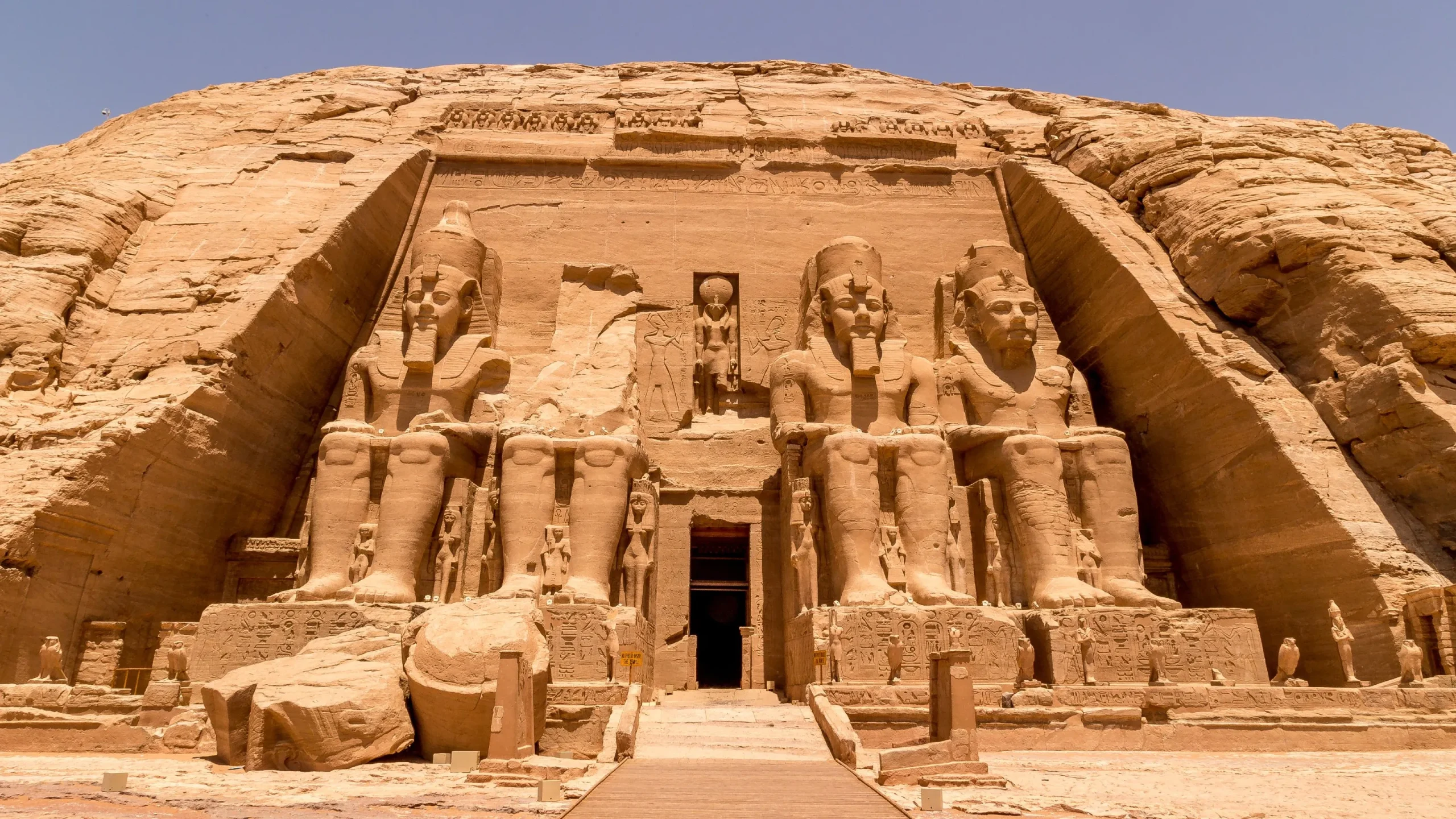
Four colossal statues of Ramesses II gazing across Lake Nasser make the Abu Simbel temples one of the most powerful sights in Egypt. However, they are more than a photo opportunity. They are a carefully designed political statement, a sophisticated solar monument and, thanks to an extraordinary rescue in the 1960s, a symbol of international cooperation. Here is the story behind them.
At a glance
- Built by: Ramesses II, 19th Dynasty, in the 13th century BC
- Temples: the Great Temple of Ramesses II and the Small Temple of Nefertari and Hathor
- Colossi: four seated statues of the king, each about 20 m high
- Sun festival: around 22 February and 22 October
- Relocated: 1964–1968, about 65 m higher, in a UNESCO-led rescue
- Location: about 280 km south of Aswan, near the Sudanese border
Why build temples here?
Abu Simbel lies deep in Nubia, the land south of Egypt’s traditional border at Aswan, rich in gold and a key route for trade from Africa. Ramesses II, who reigned for some 66 years, built several temples in Nubia, but Abu Simbel was the grandest. As a result, anyone travelling north on the Nile met four giant images of the king, a clear message of Egyptian power and of the king’s divine status.
The Great Temple
First, the Great Temple is cut entirely into the sandstone cliff. Its façade is dominated by four seated colossi of Ramesses II, one of which lost its upper part in an earthquake in antiquity. Smaller figures of the king’s mother, his queen Nefertari and some of his children stand by his legs. Above the entrance, the falcon-headed sun god Ra-Horakhty forms a visual pun on the king’s throne name.
Inside, a hall lined with eight huge statues of the king as Osiris leads deeper into the mountain. The walls show Ramesses’s military campaigns, above all the Battle of Kadesh against the Hittites (around 1274 BC), presented as a great personal victory – although the battle was in reality closer to a draw and later ended in a peace treaty. At the very back, the sanctuary holds four seated statues: Ptah, Amun-Ra, the deified Ramesses II and Ra-Horakhty.
The sun festival
In addition, the temple was aligned so that, twice a year, the rising sun shines along the entire length of the temple, about 60 m, and lights up the statues in the sanctuary. Ptah, a god connected with the underworld, remains in shadow. The phenomenon happens around 22 February and 22 October, dates often linked to the king’s jubilee or coronation, although there is no ancient text that confirms this. Thousands of visitors gather at dawn to watch it.
Plan your visit
Add Abu Simbel to your Aswan stay or Egypt itinerary, with a licensed Egyptologist guide.
The Small Temple of Nefertari
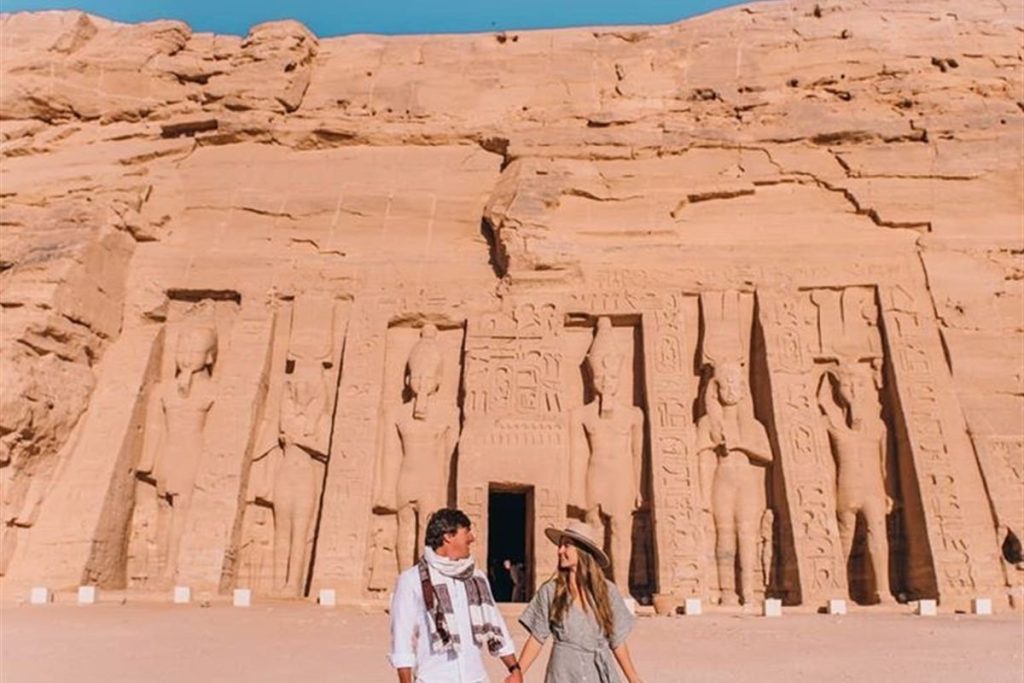
Next to it, a smaller temple honours the goddess Hathor and Ramesses’s chief wife, Nefertari. Its façade has six standing statues, four of the king and two of the queen, all about the same height – a rare honour for a queen in Egyptian art. Inside, delicate reliefs show Nefertari making offerings to the gods. It is one of the clearest expressions of a pharaoh’s affection for his queen.
Rediscovery and rescue
Over the centuries, however, sand buried most of the Great Temple. The Swiss traveller Johann Ludwig Burckhardt saw the tops of the colossi in 1813, and Giovanni Belzoni dug his way inside in 1817.
Then, in the 1950s, the construction of the Aswan High Dam threatened to flood the temples under the new lake. In 1960 UNESCO launched an international campaign to save the monuments of Nubia. Between 1964 and 1968 engineers cut both temples into more than a thousand large blocks, lifted them about 65 m higher and around 200 m back from the river, and reassembled them against an artificial hill built over a concrete dome. The sun alignment still works, now about a day later than before. The same campaign moved other temples, including Philae, and UNESCO’s World Heritage Convention grew out of its success.
Visiting Abu Simbel
In practical terms, Abu Simbel is about 280 km from Aswan. Most visitors go by road, around three and a half hours each way, leaving Aswan very early, or by a short domestic flight. Some cruises on Lake Nasser also stop here. Staying overnight in the village lets you see the temples at sunrise and the evening sound and light show. Finally, bring a hat and water: the forecourt is exposed and hot.
Frequently asked questions
When is the Abu Simbel sun festival?
Around 22 February and 22 October each year, at sunrise, when the sun lights up the statues in the temple sanctuary.
Why were the Abu Simbel temples moved?
To save them from the waters of Lake Nasser created by the Aswan High Dam. They were cut into blocks and rebuilt 65 m higher between 1964 and 1968.
How far is Abu Simbel from Aswan?
About 280 km, roughly three and a half hours by road, or a short flight.
Is Abu Simbel worth the trip?
Yes. Most visitors consider it one of the highlights of Egypt, for the colossal statues, the interior reliefs and the remarkable story of its rescue.
Sources & further reading
- UNESCO World Heritage – Nubian Monuments from Abu Simbel to Philae
- UNESCO – The Rescue of Nubian Monuments and Sites
Written by the Deluxe Travel Egypt team and checked against the published sources above. Last updated October 2026.
See Ramesses’ masterpiece
We arrange early transfers, flights or overnight stays so you can enjoy Abu Simbel at its best.
Send an enquiry WhatsApp +201000569259 WhatsApp +201221418581