
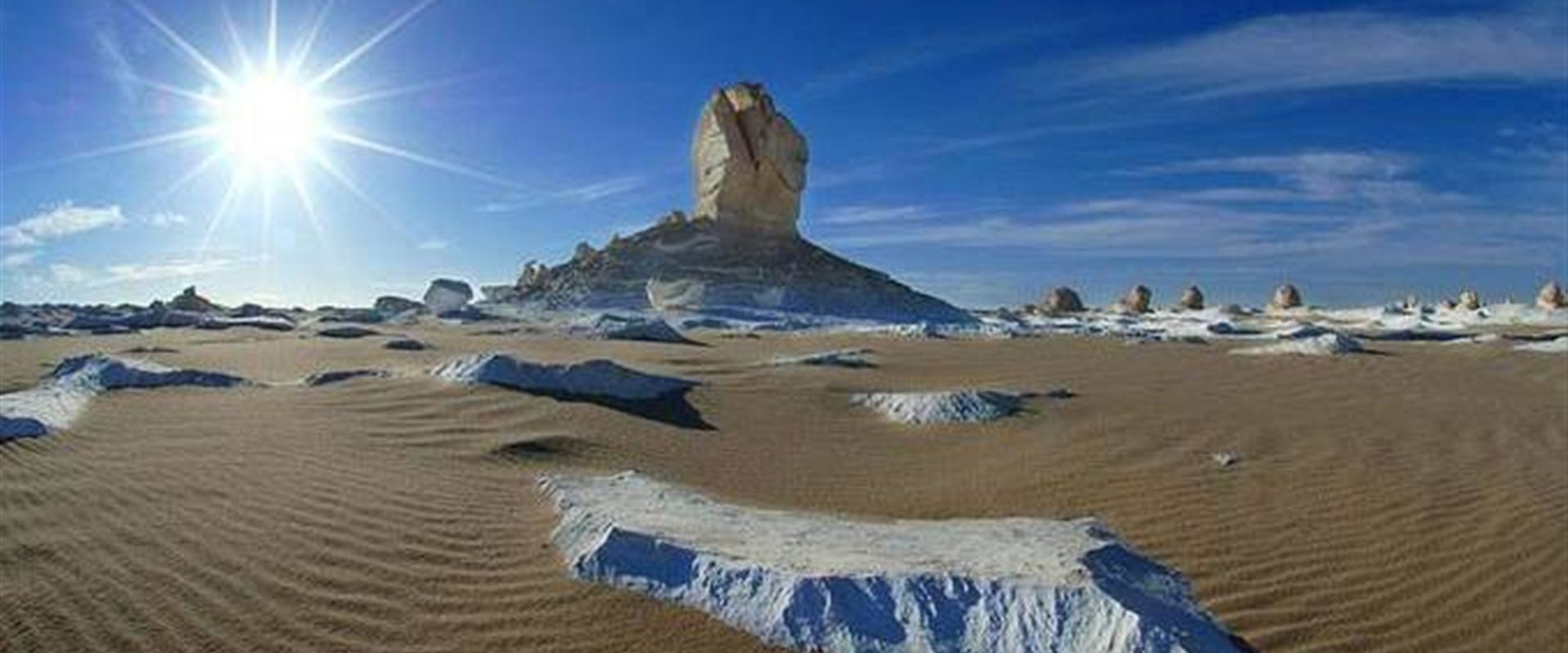
Few places on earth look as otherworldly as the White Desert in Egypt. Snow-white chalk towers rise from golden sand, sculpted by the wind into mushrooms, cones and strange animal shapes. At sunset they glow pink and orange; under a full moon they look like an Arctic landscape. This guide explains how the White Desert was formed, what you will see on the way, and how to visit in a way that protects this fragile place.
At a glance
- Location: Farafra depression, Western Desert, about 500 km south-west of Cairo
- Protected: a national park and protected area since 2002
- Rock: Late Cretaceous chalk laid down on an ancient sea floor
- Shaped by: wind-blown sand eroding the soft chalk
- Usual gateway: Bahariya Oasis, about 4–5 hours’ drive from Cairo
- Best time: October to April; winter nights can be close to freezing
An ancient sea floor in the Sahara
The white rock that gives the desert its name is chalk, a soft limestone made of the microscopic skeletons of marine organisms. In the Late Cretaceous period, many tens of millions of years ago, a shallow sea covered much of what is now the Western Desert, and these tiny shells settled on its floor in thick layers. Geologists call the rock around Farafra the Khoman Chalk. Later, however, the sea retreated, the land rose and the climate became the hyper-arid desert we know.
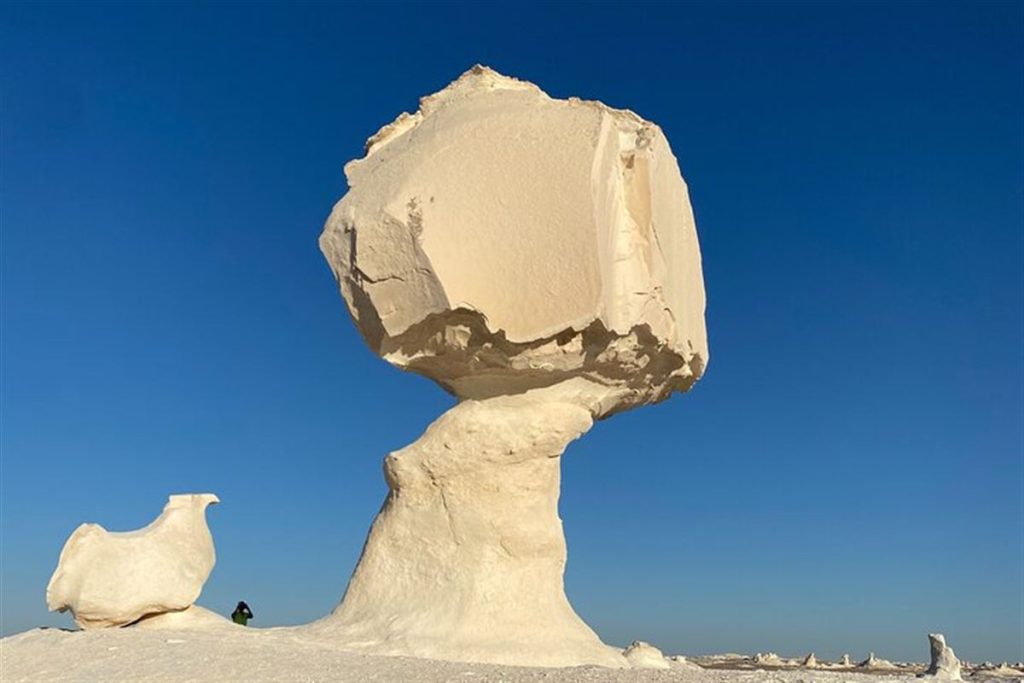
How the wind carved the formations
Above all, wind is the sculptor of the White Desert. For thousands of years it has driven sand against the chalk, wearing away softer layers faster than harder ones. Because sand travels mostly close to the ground, the base of a rock is often eroded more than its top – which explains the famous “mushroom” and “chicken” formations, with narrow stems and wide caps. Larger isolated hills of chalk standing above the plain are known as inselbergs. In addition, if you look closely you may find fossil shells, flint nodules and crystals scattered on the ground.
Plan your visit
Join a private or shared safari with experienced Bedouin guides and 4×4 vehicles.
What you will see on the way
- Bahariya Oasis – the usual starting point, with palm groves, hot springs and the Greco-Roman “Golden Mummies” found in 1996.
- The Black Desert – cone-shaped hills topped with dark volcanic and iron-rich rock, which breaks down into black gravel over the golden sand.
- Crystal Mountain – a low ridge glittering with quartz crystals beside the road.
- Agabat – a dramatic valley of white cliffs and dunes, perfect for sandboarding and photography.
- The New and Old White Desert – the main fields of chalk formations, including the Mushroom and the Chicken, and the usual camping areas.
Camping under the stars in the White Desert
For most visitors, however, the highlight of the trip is a night in the desert. Camps are usually simple: mattresses and blankets in the shelter of a chalk formation, or tents, with dinner cooked over a fire by your Bedouin guides. With no light pollution, the night sky is spectacular, and in the morning you may see the tracks of the fennec fox, which often visits camps in search of scraps. In winter, nights are cold, so warm clothes and a good sleeping bag are essential.
How to travel responsibly in the White Desert in Egypt
The chalk formations of the White Desert in Egypt are soft and slow to form: a careless footstep or vehicle can destroy in seconds what wind took thousands of years to shape. To protect the White Desert:
- Don’t climb on or carve the formations, and never break off pieces.
- Take nothing but photos. Leave fossils, crystals and stones where they are.
- Leave no trace. Pack out all rubbish, including food scraps and cigarette ends.
- Stay on established tracks and choose operators who avoid driving over fragile areas.
- Bring firewood rather than collecting dead vegetation, and keep fires small.
- Don’t feed wildlife. The foxes should remain wild.
- Travel with licensed operators, who hold the required desert permits and know the area and its safety rules.
Frequently asked questions
How was the White Desert formed?
Its chalk was deposited on the floor of a shallow sea in the Late Cretaceous, then exposed and sculpted over thousands of years by wind-blown sand into towers and mushroom shapes.
How far is the White Desert from Cairo?
About 500 km. Most trips drive about 4–5 hours to Bahariya Oasis and continue by 4×4 into the desert.
Is it safe to camp in the White Desert?
Yes, with a licensed operator and experienced guides. Bring warm clothes for winter nights and follow your guide’s safety instructions.
When is the best time to visit the White Desert?
October to April. Summer days are very hot, while winter nights can drop close to freezing.
Sources & further reading
- Hamilton College – Structure of the Khoman Chalk near Farafra Oasis (Tewksbury et al., PDF poster) – geological research on the White Desert chalk
Written by the Deluxe Travel Egypt team and checked against the published sources above. Last updated October 2026.
Sleep under the desert stars
Experienced Bedouin guides, comfortable camps and 4×4 adventures – tell us when you would like to go.
Send an enquiry WhatsApp +201000569259 WhatsApp +201221418581