
Most visitors to Cairo see the pyramids of Giza and go home. Yet the pyramids of Giza, Saqqara and Dahshur are not three versions of the same monument: they are three chapters of one story. Saqqara shows the first experiments in stone, Dahshur shows a king and his architects learning – sometimes the hard way – how to build a true pyramid, and Giza shows the result when they got it right. Visit them in that order and the pyramids suddenly make sense.
At a glance
- Saqqara: Step Pyramid of Djoser, 3rd Dynasty, around 2650 BC – the first monumental stone building
- Dahshur: Bent and Red Pyramids of Sneferu, 4th Dynasty, around 2600 BC – the first true pyramids
- Giza: Pyramids of Khufu, Khafre and Menkaure, 4th Dynasty, around 2560–2500 BC – the peak
- Distance: Saqqara and Dahshur lie about 25–40 km south of Giza
- UNESCO: all three belong to the World Heritage Site “Memphis and its Necropolis”
Why three pyramid fields?
All three sites were cemeteries of Memphis, the capital of Egypt for much of the Old Kingdom. Kings chose their burial sites along the desert edge west of the city, wherever there was good bedrock, space and a line of sight to the capital. As royal families changed, so did their favourite cemetery. The result is a strip of pyramid fields roughly 30 km long – from Abu Rawash and Giza in the north, through Abusir and Saqqara, to Dahshur in the south.
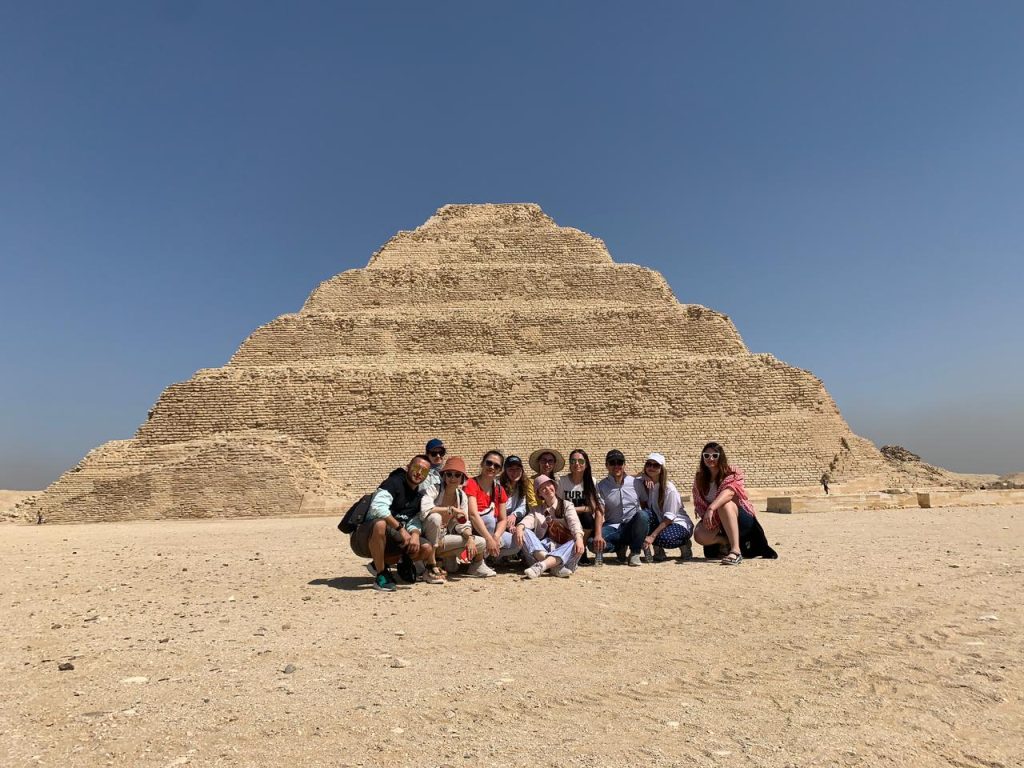
Saqqara: where it all began
Around 2650 BC, King Djoser of the 3rd Dynasty did something no one had done before: he built his tomb entirely of cut stone. His architect, traditionally named as Imhotep, began with a flat, rectangular mastaba – the usual tomb of the time – and enlarged it in stages until it became six stacked platforms about 60 m high. This is the Step Pyramid, the oldest monumental stone building in the world.
Around it lies a vast walled enclosure with dummy buildings, chapels and courts, all copying in stone the reed, wood and mudbrick architecture of the time. The Step Pyramid reopened in 2020 after a long restoration, and its underground galleries with blue faience tiles are among the most remarkable spaces in Egypt.
Later monuments at Saqqara
Saqqara remained in use for nearly 3,000 years. Later highlights include the pyramid of Unas (around 2350 BC), the first to have its burial chamber inscribed with the Pyramid Texts, the beautifully carved mastaba tombs of officials such as Ti and Mereruka, and the Serapeum, the underground gallery of the sacred Apis bulls.
Dahshur: learning to build a true pyramid
Djoser’s successors kept trying to turn steps into smooth sides. The decisive king was Sneferu, founder of the 4th Dynasty and father of Khufu. He built at least three large pyramids – more stone than any other pharaoh.
The Bent and Red Pyramids at Dahshur
At Dahshur you can see two of them. The Bent Pyramid starts with steep sides of about 54 degrees, then abruptly changes to a gentler slope of about 43 degrees part way up – most likely because the structure showed signs of instability during construction. It keeps much of its original casing, so it is the best place in Egypt to imagine how a finished pyramid looked.
A short distance north, the Red Pyramid, named after the reddish tint of its limestone, was built at that safer 43-degree angle from the start. It is regarded as Egypt’s first successful smooth-sided pyramid, and it is the third-largest after the two great pyramids of Giza. You can climb down its long passage into the corbelled chambers inside, usually with far fewer visitors than at Giza.
Dahshur was a military zone until the 1990s, which helped protect it. The site also has later pyramids of the Middle Kingdom, built of mudbrick, such as the “Black Pyramid” of Amenemhat III.
Plan your visit
See the three stages of pyramid history with a licensed Egyptologist guide and a private car.
Giza: the peak of pyramid building
With Sneferu’s experience behind him, Khufu moved to the Giza plateau and built the Great Pyramid, about 146 m high when complete. His son Khafre built a pyramid only slightly smaller, which still keeps a cap of casing at its summit, and probably the Great Sphinx beside his valley temple. Menkaure’s pyramid is much smaller but was partly cased in expensive red granite.
Each pyramid at Giza was the centre of a full complex: a valley temple by the edge of the floodplain, a causeway, a mortuary temple against the pyramid, boat pits, smaller queens’ pyramids and fields of mastaba tombs for the royal family and officials. Giza is where the system reached its most monumental, most precise form.
After Giza: smaller pyramids, new ideas
Later kings of the 5th and 6th Dynasties built smaller pyramids at Abusir and Saqqara, with cores of rougher stone. Their energy went into temples, sun temples and, from Unas onwards, the religious texts carved inside. In the Middle Kingdom, pyramids returned at Dahshur, Lisht and the Fayoum, often in mudbrick. By the New Kingdom, kings had stopped building pyramids altogether and were cut into the rock of the Valley of the Kings at Thebes. Seen together, Saqqara and Dahshur explain how Giza became possible.
How to see Giza, Saqqara and Dahshur in one trip
Saqqara and Dahshur fit easily into a single day from Cairo, often combined with Memphis, where you can see the colossal limestone statue of Ramesses II in the open-air museum at Mit Rahina. Giza and the Grand Egyptian Museum make a second day. If you only have one day, start early at Giza and finish at Saqqara: the contrast between the Step Pyramid and the Great Pyramid tells the story in a few hours.
Frequently asked questions
Which is older, Saqqara or Giza?
Saqqara. The Step Pyramid of Djoser was built around 2650 BC, roughly a century before the Great Pyramid of Giza.
Is Dahshur worth visiting?
Yes, especially if you are interested in how the pyramids developed. The Bent and Red Pyramids are the direct ancestors of Giza, the site is quiet, and you can go inside the Red Pyramid.
Can you go inside the pyramids at Saqqara and Dahshur?
Usually yes. The Red Pyramid at Dahshur and the Step Pyramid and several later pyramids and tombs at Saqqara can normally be entered, although openings change from time to time.
How far is Dahshur from Cairo?
Dahshur is about 40 km south of Giza. With a private car, Saqqara and Dahshur are easily combined in one day.
Sources & further reading
- UNESCO World Heritage – Memphis and its Necropolis – the Pyramid Fields from Giza to Dahshur
- The Metropolitan Museum of Art – Egyptian Art in the Age of the Pyramids (free to read online) – includes chapters on Djoser, Sneferu and the Giza kings
- Digital Giza (Harvard University) – maps, photographs and records of the Giza necropolis
Written by the Deluxe Travel Egypt team and checked against the published sources above. Last updated October 2026.
From the first pyramid to the greatest
Let us plan a private day at Saqqara and Dahshur, or combine all three pyramid fields in one trip.
Send an enquiry WhatsApp +201000569259 WhatsApp +201221418581