
Imhotep is one of the very few non-royal Egyptians whose name is still famous today. Thanks to films he is often imagined as a sinister priest, but the real man was something far more interesting: a senior official of King Djoser, linked to the first great stone building in history. So who was Imhotep, what do we actually know about him, and how did a human architect end up worshipped as a god?
At a glance
- Lived: 3rd Dynasty, around 2650 BC, under King Djoser
- Known for: the Step Pyramid complex at Saqqara, the first monumental stone architecture
- Evidence: his name and titles on the base of a statue of Djoser found at Saqqara
- Later fame: worshipped as a god of wisdom and medicine; the Greeks linked him with Asklepios
- Tomb: never identified; probably somewhere in North Saqqara
The evidence: a name on a statue base
For a long time Imhotep was known only from much later traditions. That changed in the 1920s, when excavators at Saqqara found the base of a statue of King Djoser near the Step Pyramid. Next to the king’s name it carries the name and titles of Imhotep: chancellor of the king of Lower Egypt, “first after the king”, administrator of the great palace, hereditary noble and high priest of Heliopolis – and, tellingly, “builder” and “sculptor”. The base is now in the collections of the Egyptian museums in Cairo.
A royal statue that names a private person is extremely unusual for the period. It shows that Imhotep held a very special position at Djoser’s court. His name also appears in graffiti at the unfinished pyramid enclosure of Djoser’s successor, Sekhemkhet, suggesting that he continued to serve after Djoser.
What Imhotep changed
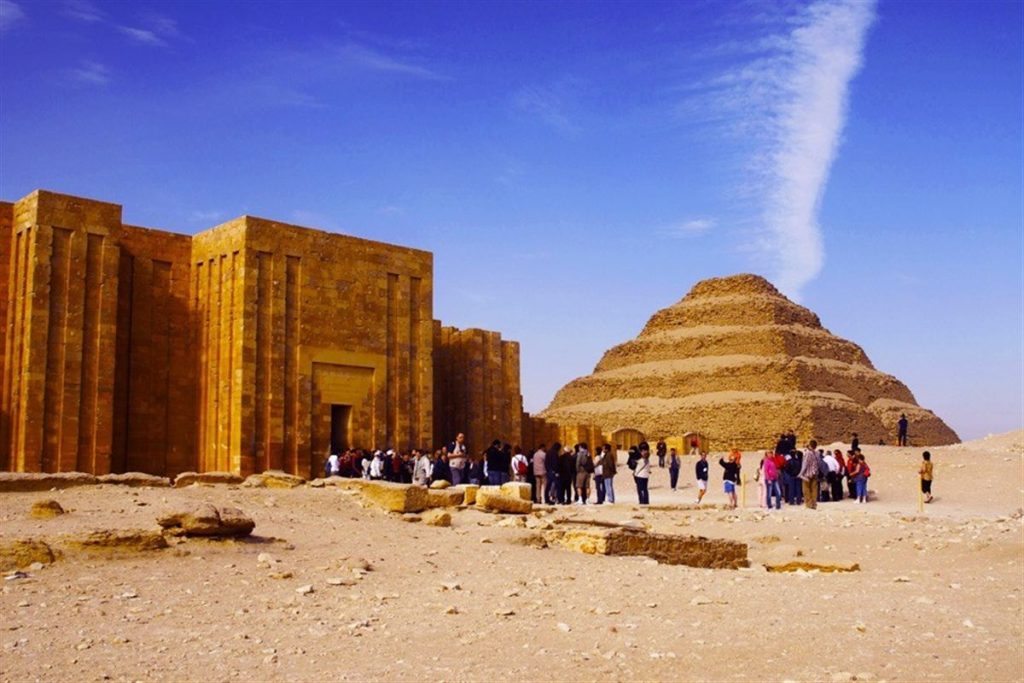
Before Djoser, royal and elite tombs were rectangular mastabas built mainly of mudbrick, with stone used sparingly. The Step Pyramid complex translated an entire royal architecture into stone for the first time. Columns imitate bundles of reeds, ceilings imitate log roofs, and doors are carved permanently ajar. The pyramid itself grew in stages: a stone mastaba was enlarged, then built up into four and finally six steps, reaching about 60 m.
Around it a stone enclosure wall more than 1.5 km long surrounds courts, chapels and dummy buildings linked to the royal jubilee festival, the heb-sed. Below ground, a maze of corridors includes chambers decorated with blue-green faience tiles and fine reliefs of the king. Whoever designed it – and Egyptian tradition firmly credits Imhotep – created the model that led, within a century, to the true pyramids of Dahshur and Giza.
Plan your visit
Walk through Djoser’s complex and the Imhotep Museum with a licensed Egyptologist.
From official to god
Egyptians remembered Imhotep for more than 2,000 years. In the New Kingdom he was honoured by scribes as a patron of their craft and quoted as a sage; a famous harper’s song mentions “the words of Imhotep and Hardjedef”. By the Late Period he had been fully deified as the son of the creator god Ptah of Memphis, a god of wisdom and healing. Small bronze statues show him seated, with a papyrus roll on his knees.
Under Greek and Roman rule his cult flourished. The Greeks called him Imouthes and identified him with Asklepios, their god of medicine. Pilgrims came to his sanctuary at Saqqara hoping for cures, and a small temple to Imhotep stands on the island of Philae near Aswan.
Myths and misconceptions
- “Imhotep wrote the first medical texts.” There is no contemporary evidence for this. His reputation as a healer comes from his later cult, not from writings that survive from his lifetime.
- “His tomb has been found.” Not yet. Several large tombs in North Saqqara have been suggested, but none has been proven to be his.
- “He was a sinister priest.” That is Hollywood. The real Imhotep was a high-ranking administrator, high priest and builder admired for his wisdom.
Seeing Imhotep’s legacy today
The best way to understand Imhotep is to stand in front of the Step Pyramid and walk through the colonnaded entrance of Djoser’s enclosure. Next to the site, the Imhotep Museum at Saqqara displays finds from the necropolis and is dedicated to his memory. Combine the visit with Dahshur to see how Sneferu’s architects took Imhotep’s idea to the next level, and with Giza to see where it ended.
Frequently asked questions
What is Imhotep famous for?
Imhotep is famous as the official traditionally credited with designing the Step Pyramid of Djoser at Saqqara, the first monumental stone building, and later as a god of wisdom and medicine.
Was Imhotep a real person?
Yes. His name and titles appear on a statue base of King Djoser from Saqqara, a contemporary piece of evidence from around 2650 BC.
Where is Imhotep buried?
His tomb has not been identified. Most Egyptologists expect it to be in North Saqqara, near the monuments of the king he served.
Is there a museum about Imhotep?
Yes. The Imhotep Museum stands at the entrance to the Saqqara necropolis and displays finds from the site.
Sources & further reading
- UNESCO World Heritage – Memphis and its Necropolis (including Saqqara)
- The Metropolitan Museum of Art – Egyptian Art in the Age of the Pyramids (free to read online) – with essays on Djoser’s complex at Saqqara
Written by the Deluxe Travel Egypt team and checked against the published sources above. Last updated October 2026.
Visit the world’s first pyramid
A private day at Saqqara and Dahshur with an Egyptologist guide shows you how Imhotep’s idea became the pyramids.
Send an enquiry WhatsApp +201000569259 WhatsApp +201221418581