
When Howard Carter looked into the tomb of Tutankhamun in November 1922, he saw gold everywhere. A century later, the gold is still dazzling, but its real value lies elsewhere. Tutankhamun’s tomb is the only royal burial of ancient Egypt’s New Kingdom found largely intact, and the study of its contents – from DNA to wine labels – has told us more about a pharaoh’s life and death than any other discovery. Here is what it actually revealed.
At a glance
- Discovered: November 1922 by Howard Carter, funded by Lord Carnarvon
- Tomb number: KV62, Valley of the Kings, Luxor West Bank
- King: Tutankhamun, 18th Dynasty, reigned around 1332–1323 BC
- Age at death: about 18–19 years old
- Objects: more than 5,000, now in the Grand Egyptian Museum
- Clearance: took Carter’s team about ten years
The discovery of the tomb of Tutankhamun
By 1922 many experts believed the Valley of the Kings was exhausted. Carter disagreed and, with the support of his patron Lord Carnarvon, kept digging. On 4 November his workmen uncovered a step cut into the rock just below the entrance of the tomb of Ramesses VI. A staircase led down to a sealed doorway bearing the name of Tutankhamun. On 26 November Carter made a small hole in the inner doorway and, by candlelight, saw the crowded antechamber beyond.
The tomb had four small rooms: the antechamber, a side annex, the burial chamber and the so-called treasury. Robbers had entered it at least twice in antiquity, but officials caught or disturbed them and resealed the tomb. That is why it survived.
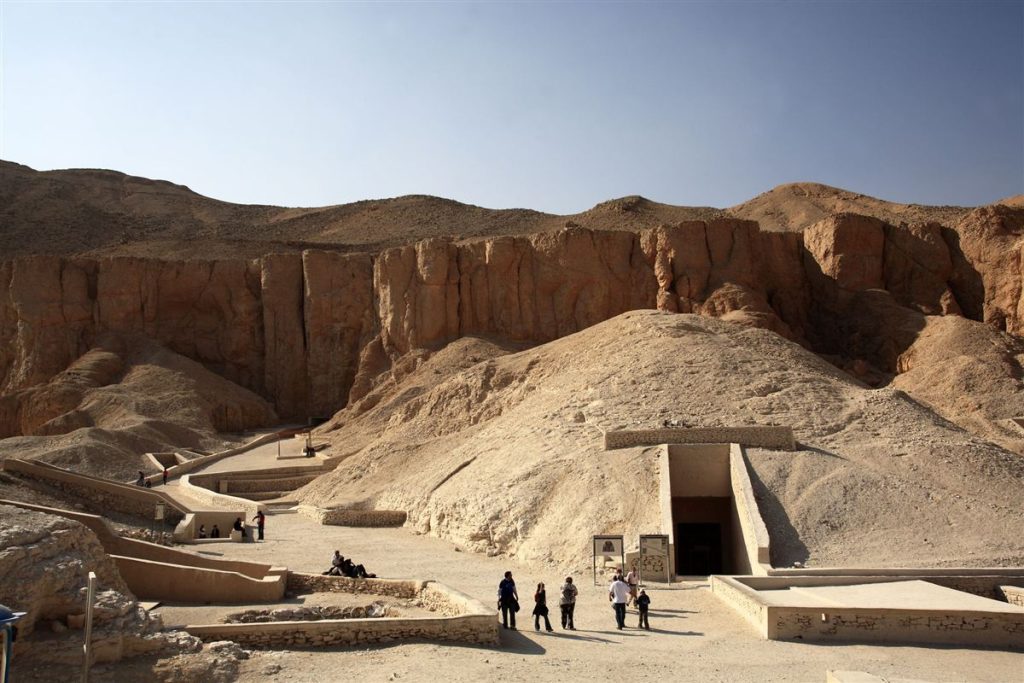
A small tomb for a young king
The tomb of Tutankhamun, KV62, is tiny compared with other royal tombs in the valley, and only the burial chamber is decorated. In fact, many Egyptologists think it was not originally intended for a king and was adapted in a hurry after Tutankhamun’s unexpected death. Small brown spots on the painted walls are the remains of microbial growth, suggesting the paint was still damp when the tomb was sealed. Some objects in the tomb, including the small gold coffins for his internal organs, were originally made for an earlier ruler and adapted for him.
Who was Tutankhamun?
Tutankhamun came to the throne as a child of about eight or nine, at the end of a period of religious upheaval. His father was almost certainly the “heretic” king Akhenaten, who had promoted the worship of the sun disc, the Aten, and moved the capital to Amarna. The young king was born Tutankhaten; he changed his name to Tutankhamun, returned the court from Amarna and restored the old gods, a policy recorded on his “restoration stela”.
DNA studies published in 2010 analysed the king and several mummies from the royal family. They supported the identification of his father and showed that his parents were closely related. Two tiny mummified foetuses found in the tomb were probably his daughters with his wife, Ankhesenamun.
Plan your visit
Follow Tutankhamun from his tomb in Luxor to his treasures at the GEM, with a licensed Egyptologist.
How did Tutankhamun die?
This remains debated. Most experts now reject older theories of murder, based on bone fragments in the skull: the damage is better explained by embalming or by Carter’s 1925 examination. CT scans show a fracture of the left leg that may have occurred shortly before death, and genetic studies have reported evidence of malaria. A combination of illness and an infected injury is the most common explanation today, but no single cause has been proven.
What the objects in the tomb of Tutankhamun tell us
The treasures range from the spectacular to the everyday:
- The burial ensemble – four gilded wooden shrines nested inside each other, a stone sarcophagus and three coffins, the innermost of solid gold, enclosing the mummy and its famous gold mask inlaid with lapis lazuli, quartz and coloured glass.
- Kingship – thrones, sceptres, crooks and flails, ceremonial chariots and weapons.
- Daily life – linen garments, gloves, sandals, beds, chests, board games of senet, writing equipment and baskets of food.
- Wine jars labelled with the year, the vineyard and the name of the wine-maker – the ancient equivalent of a vintage.
- Technology – a dagger whose blade, analysed in 2016, was made of meteoritic iron, and two trumpets that were played on a BBC radio broadcast in 1939.
Together they show the full equipment a king took into the afterlife, and many items he used in life.
The “curse” and the real legacy
When Lord Carnarvon died in Cairo in April 1923 from an infected mosquito bite, newspapers invented the “curse of the pharaohs”. Carter himself, who spent a decade inside the tomb, lived until 1939. The real legacy of the discovery is scientific: Carter’s meticulous records, photographs by Harry Burton and notes on every object, now preserved at the Griffith Institute in Oxford, remain a model for archaeologists. Today the tomb of Tutankhamun itself can be visited in the Valley of the Kings, with the king’s mummy still inside, while his treasures are displayed together at the Grand Egyptian Museum.
Frequently asked questions
Where is Tutankhamun’s tomb?
In the Valley of the Kings on the West Bank of Luxor. It is known as KV62 and can be visited with a separate ticket.
Where are Tutankhamun’s treasures today?
His treasures, including the gold mask, are displayed together at the Grand Egyptian Museum near the Giza pyramids. His mummy remains in his tomb in Luxor.
How old was Tutankhamun when he died?
About 18 or 19 years old, after a reign of around nine to ten years.
Is the curse of Tutankhamun real?
No. It was a newspaper story after Lord Carnarvon died of an infection in 1923. Most members of the excavation team lived long lives.
Sources & further reading
- Griffith Institute, University of Oxford – Tutankhamun Spatial Archive – explore the tomb through Howard Carter’s original excavation records
- The Metropolitan Museum of Art – Tutankhamun’s Funeral (free to read online)
- Theban Mapping Project – Valley of the Kings
- UNESCO World Heritage – Ancient Thebes with its Necropolis
Written by the Deluxe Travel Egypt team and checked against the published sources above. Last updated October 2026.
Walk in the footsteps of Howard Carter
From the Valley of the Kings to the Grand Egyptian Museum, we plan private Tutankhamun itineraries with expert guides.
Send an enquiry WhatsApp +201000569259 WhatsApp +201221418581