
No custom is more closely linked with ancient Egypt than mummification. Yet for the Egyptians it was not about horror or curses: it was a careful religious and technical process designed to give the dead a body that would last for eternity. This guide explains the beliefs behind ancient Egyptian mummification, the steps the embalmers followed, and what recent archaeology has added to the picture.
At a glance
- Purpose: to preserve the body as an eternal home for the spirit
- Duration: about 70 days for a full, high-status embalming
- Key material: natron, a natural salt used to dry the body
- Organs: usually removed and stored in four canopic jars; the heart was left in place
- Best evidence: mummies, embalming caches, texts and an embalming workshop excavated at Saqqara
- Where to see mummies: the National Museum of Egyptian Civilization in Cairo and the Mummification Museum in Luxor
Why the Egyptians preserved the dead
To understand ancient Egyptian mummification, it helps to know that the Egyptians believed a person was made of several parts. Besides the physical body there was the ka, the life force, and the ba, often shown as a bird with a human head, which could travel between the tomb and the world of the living. After death the ka and ba needed a recognisable body to return to. If the body perished, the person’s survival in the afterlife was at risk.
The model for this was the god Osiris. In myth, his brother Seth murdered Osiris and scattered his body; his wife Isis gathered the pieces, and the jackal god Anubis wrapped him as the first mummy, allowing him to live again as ruler of the underworld. Every mummification repeated this divine act, and the dead person became, in a sense, “an Osiris”.
From the desert sand to deliberate embalming
The earliest Egyptians buried their dead in shallow pits in the hot, dry desert, where bodies sometimes dried out naturally. Over time burials became more elaborate, with coffins and chambers that actually kept the body away from the drying sand, so people began to preserve the dead deliberately. Traces of resins and linen wrappings show that experiments with embalming had begun long before the pyramids. Ancient Egyptian mummification was refined over many centuries and reached its most sophisticated form in the New Kingdom and the period after it.
How ancient Egyptian mummification worked, step by step
Our most detailed written account comes from the Greek historian Herodotus in the 5th century BC, who described three levels of embalming at different prices. Combined with the study of mummies, it allows us to reconstruct the best-quality method:
- Purification. Embalmers washed the body and took it to their workshop.
- Removing the brain. In many periods, embalmers broke up the brain and removed it through the nose with a hook. The Egyptians did not think it was important.
- Removing the organs. An incision on the left side allowed the embalmer to remove the lungs, liver, stomach and intestines. The embalmers dried them and placed them in four canopic jars protected by the Four Sons of Horus. The heart, seen as the seat of thought and memory, normally stayed in the body.
- Drying. Next, the embalmers covered and packed the body with natron, a natural salt from places such as the Wadi Natrun, for about 40 days.
- Anointing and padding. After that, they treated the dried body with oils and resins and padded it with linen to restore its shape.
- Wrapping. Finally, they wound hundreds of metres of linen around the body, with amulets placed between the layers, such as a heart scarab over the chest. Priests recited spells throughout.
- Burial. After about 70 days, the family placed the mummy in its coffin and took it to the tomb, where the Opening of the Mouth ceremony restored its senses.
Plan your visit
See mummies, embalming tools and royal tombs with a licensed Egyptologist.
The judgement of the dead
A preserved body was necessary but not sufficient. According to the Book of the Dead, the deceased had to pass through the Hall of Judgement, where the gods weighed his or her heart against the feather of Maat, the goddess of truth and order. The monster Ammit devoured a heart heavy with wrongdoing; a heart in balance allowed the dead to enter the fields of the blessed. This is why the heart stayed in the body, and why the heart scarab carried a spell asking the heart not to testify against its owner.
What archaeology has revealed
Modern science has transformed our understanding of ancient Egyptian mummification. CT scans let researchers study mummies without unwrapping them, revealing age, health, diseases and embalming techniques.
One of the most important recent finds is an embalming workshop at Saqqara dating to the 26th Dynasty (7th–6th century BC), excavated by a German-Egyptian team. The embalmers had labelled dozens of its pottery vessels with their contents or instructions. Chemical analysis published in Nature in 2023 identified the actual oils, tars and resins used to embalm the head and treat the wrappings. Some ingredients came from the Mediterranean, but others, such as dammar and elemi resins, came from tropical forest regions far away – evidence of long-distance trade supplying the embalmers.
Egypt also preserved millions of animal mummies: cats, ibises, falcons, crocodiles and more, mostly offered to the gods by pilgrims in the Late Period. Archaeologists have found whole catacombs of them at sites such as Saqqara.
Where to see mummies in Egypt
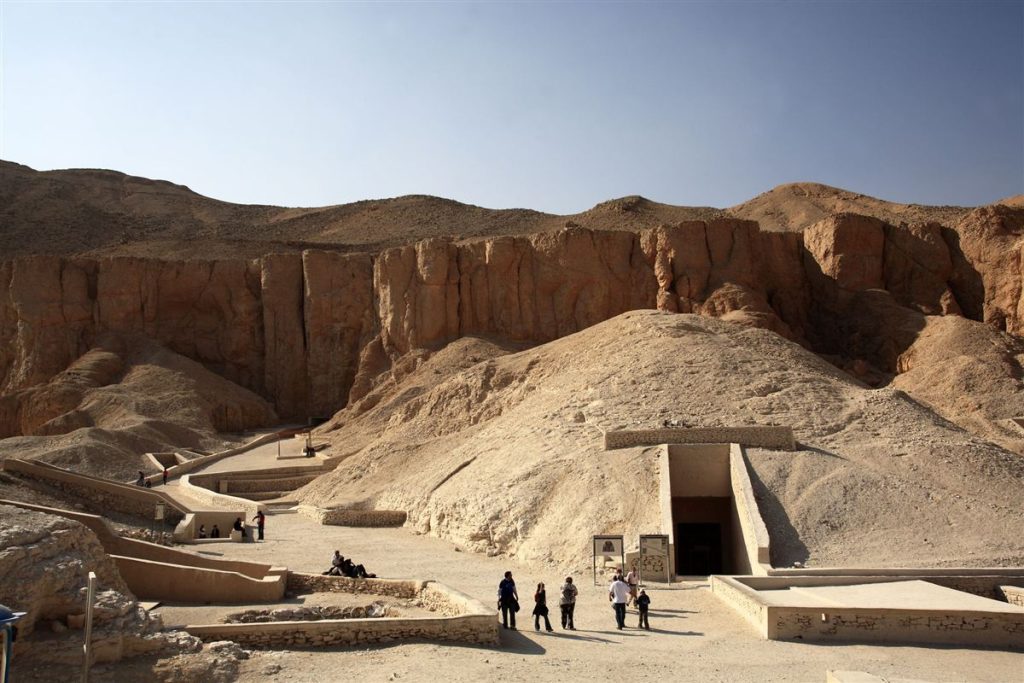
In April 2021 the royal mummies of the New Kingdom, including Ramesses II and Hatshepsut, travelled in a public procession to the National Museum of Egyptian Civilization in Fustat, Cairo, where they now rest in a dedicated gallery. In Luxor, the small and excellent Mummification Museum on the Corniche explains the process with tools, materials and animal mummies. The tombs of the Valley of the Kings on Luxor’s West Bank, where many of these kings were first buried, complete the story.
Frequently asked questions
How long did mummification take?
A full, high-quality embalming took about 70 days, including roughly 40 days of drying the body in natron.
Why did the Egyptians leave the heart in the body?
They believed the heart was the seat of thought, memory and character. The dead needed it for the judgement, when the gods weighed it against the feather of Maat.
Were only pharaohs mummified?
No. Anyone whose family could afford it could be embalmed, and cheaper methods existed. Animals were mummified in huge numbers as well.
Where can I see royal mummies in Cairo?
The royal mummies are displayed at the National Museum of Egyptian Civilization (NMEC) in Fustat, Old Cairo.
Sources & further reading
- Nature (2023) – Biomolecular analyses enable new insights into ancient Egyptian embalming – study of the Saqqara embalming workshop
- The Metropolitan Museum of Art – Tutankhamun’s Funeral (free to read online) – on the embalming cache from the Valley of the Kings
- Theban Mapping Project – plans and descriptions of the royal tombs at Luxor
- UNESCO World Heritage – Ancient Thebes with its Necropolis
Written by the Deluxe Travel Egypt team and checked against the published sources above. Last updated October 2026.
Discover the world of the pharaohs’ afterlife
From the royal mummies in Cairo to the tombs of Luxor, we can plan a private itinerary around your interests.
Send an enquiry WhatsApp +201000569259 WhatsApp +201221418581