
Every temple wall and tomb in Egypt is covered in writing. To most visitors Egyptian hieroglyphs look like beautiful but impenetrable pictures. In fact the system is logical, and with a few basic rules you can start recognising royal names, common words and the direction of a text on your very first day. This guide explains how hieroglyphs work and how scholars learned to read them again after more than 1,400 years of silence.
At a glance
- In use: from around 3200 BC to AD 394 (the last dated inscription, at Philae)
- Number of signs: several hundred in classical use; thousands in the Greco-Roman period
- Types of sign: sound signs, word signs and silent “determinatives”
- Vowels: not written
- Direction: right to left, left to right or in columns – read towards the faces
- Key to decipherment: the Rosetta Stone, deciphered by Jean-François Champollion in 1822
Egyptian hieroglyphs: pictures that are not (only) pictures
The most common mistake is to think that Egyptian hieroglyphs simply stand for the things they show. Some do, but most do not. Egyptian writing combined three kinds of signs:
- Sound signs (phonograms). About two dozen signs represent single consonants – a horned viper for f, an owl for m, a water ripple for n. Many more signs represent two or three consonants together.
- Word signs (logograms). A sign can stand for a whole word, usually with a short stroke beneath it: a sun disc with a stroke means “sun” or the sun god Ra.
- Determinatives. Silent signs at the end of a word show its category: a seated man for male persons, a walking pair of legs for verbs of movement, a papyrus roll for abstract ideas, a house plan for buildings.
A typical word mixes sound signs to spell it and a determinative to clarify it, a bit like spelling a word and then adding an emoji.
No vowels, and a pronunciation convention
Like Arabic and Hebrew, Egyptian writing recorded consonants but not vowels. We know the consonants of the word for “good” or “beautiful” were n-f-r, but not exactly how it was pronounced. Egyptologists insert a short “e” between consonants to make words speakable, which is why we say nefer – as in Nefertari or Nefertiti. Coptic, the last stage of the Egyptian language written in an alphabet, gives some clues to the original vowels.
Which way do you read?
Hieroglyphs can run right to left, left to right or in vertical columns, depending on what looked best on the monument. The rule is simple: people and animals face the beginning of the line. If the birds and figures look to the right, start reading from the right. Signs are grouped into neat squares, read top to bottom within each group. On temple doorways you often see the same text written in mirror image on both sides, so each version faces the centre.
Plan your visit
Our licensed Egyptologist guides read hieroglyphs on site and love teaching guests to spot royal names.
Reading a cartouche
The easiest thing to recognise is a cartouche, the oval loop enclosing a royal name. It represents a rope tied at one end, a symbol of the king’s rule over everything the sun encircles. Each king had five official names; two of them, the throne name and the birth name, were written in cartouches.
Look for recurring elements: the sun disc of Ra (in names such as Ramesses, “Ra is the one who bore him”), the seated god Amun (in Tutankhamun, “living image of Amun”), or the ankh, the sign of life. After royal names you will often see three small signs meaning “life, prosperity, health” – an ancient “long live the king”.
Hieroglyphs, hieratic, demotic and Coptic
Egyptian hieroglyphs were mainly used for monuments and sacred texts. For everyday writing on papyrus, scribes used hieratic, a fast, cursive form of the same script. From around 650 BC an even more abbreviated script, demotic, became standard for administration and contracts. Finally, in the Roman and Christian periods, Egyptian was written in the Greek alphabet plus a few extra letters taken from demotic: this is Coptic, still used today in the liturgy of the Coptic Church.
How the Rosetta Stone cracked the code
After the temples closed in the 4th and 5th centuries AD, however, knowledge of Egyptian hieroglyphs was lost. In 1799 French soldiers found a broken stela near the town of Rashid (Rosetta) in the Nile Delta. It carries a priestly decree of 196 BC in three scripts: hieroglyphs, demotic and Greek. Because scholars could read the Greek, they had a key.
The English scientist Thomas Young recognised that the cartouches contained royal names. The French scholar Jean-François Champollion, who knew Coptic, went further: in 1822 he showed that hieroglyphs combine sound signs with word signs, and he could read names and then whole texts. The Rosetta Stone is now in the British Museum in London; a replica stands in the Egyptian Museum in Cairo.
Try it on your visit
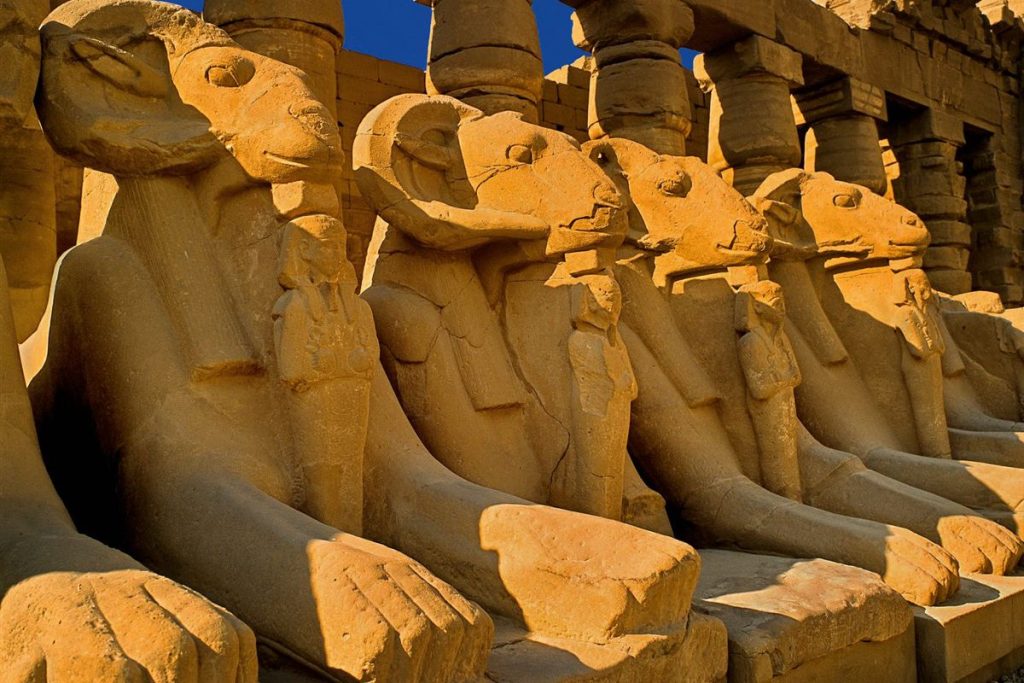
On your first temple visit, try three things: find a cartouche and identify the sun disc or Amun sign; work out the reading direction from the way the birds face; and look for the ankh and the “life, prosperity, health” group. Karnak Temple in Luxor, with its forest of inscribed columns, and the Grand Egyptian Museum are perfect places to practise – especially with a guide who can read the texts aloud.
Frequently asked questions
Are Egyptian hieroglyphs an alphabet?
No. About two dozen signs work like letters for single consonants, but the system also uses signs for groups of consonants, whole words and silent determinatives.
How many hieroglyphs are there?
In the classical period scribes used several hundred common signs. In Greco-Roman temple inscriptions the number grew into the thousands.
When were hieroglyphs last used?
The last known dated hieroglyphic inscription was carved at the temple of Philae near Aswan in AD 394.
Where is the Rosetta Stone?
The original is in the British Museum in London. A replica can be seen in the Egyptian Museum in Tahrir Square, Cairo.
Sources & further reading
- The British Museum – The Rosetta Stone (EA 24)
- Smithsonian Magazine – How the Rosetta Stone was deciphered
- UNESCO World Heritage – Nubian Monuments from Abu Simbel to Philae – including the temple of Philae, site of the last hieroglyphic inscription
Written by the Deluxe Travel Egypt team and checked against the published sources above. Last updated October 2026.
Learn to read the temple walls
Explore Karnak, Luxor and the GEM with an Egyptologist who can read the hieroglyphs for you.
Send an enquiry WhatsApp +201000569259 WhatsApp +201221418581