
For more than 4,500 years the Great Pyramid of Giza has made people ask the same question: how did anyone build this? The good news is that we no longer have to guess. Excavations at Giza, quarries, harbours and papyri have given Egyptologists a detailed picture of how the Great Pyramid was built – who did the work, where the stone came from and how the builders moved it. Experts still debate some questions, especially how the builders raised the blocks, but the overall story is clear, and it is a very human one.
At a glance
- Built for: King Khufu (Cheops), 4th Dynasty, around 2560 BC
- Original height: about 146 m (481 ft); today about 138 m
- Base: about 230 m per side, covering some 5.3 hectares
- Blocks: roughly 2.3 million, most of local limestone
- Building time: probably about 20 years, within Khufu’s reign
- UNESCO: part of “Memphis and its Necropolis – the Pyramid Fields from Giza to Dahshur” (1979)
A king, an architect and a plan
The Great Pyramid belonged to Khufu, the second king of the 4th Dynasty of the Old Kingdom. His father Sneferu had already experimented with true pyramids at Meidum and Dahshur, so Khufu’s builders inherited a generation of hard-won experience. Ancient titles and tomb inscriptions point to Hemiunu, a royal relative and “overseer of all the king’s works”, as the official most closely associated with the project; his tomb lies in the cemetery right beside the pyramid.
The first task was the site. The builders chose the northern edge of the Giza plateau, a solid limestone ridge that could carry the weight. They levelled the rock base with remarkable accuracy and oriented the four sides to the cardinal points with an error of only a few arc-minutes – probably using careful observations of the stars or the sun.
Where the stone came from
Most of the pyramid is made of the plateau itself. Workers cut the core blocks from quarries a few hundred metres south of the monument; you can still see the quarry faces today. These blocks average around two to three tonnes, though they vary considerably in size.
The smooth outer casing, now almost entirely stripped away, used a finer white limestone from Tura, on the east bank of the Nile. The burial chamber, known as the King’s Chamber, is lined and roofed with red granite from Aswan, more than 800 km upriver; some of its roof beams weigh dozens of tonnes. Copper chisels, stone pounders, wooden levers and abrasive sand were the main tools. There is no evidence of anything more exotic.
The papyri of Merer: a 4,500-year-old logbook
In 2013 a French mission led by Pierre Tallet found the oldest inscribed papyri yet known at Wadi al-Jarf, an ancient harbour on the Red Sea coast. Among them is the logbook of an official named Merer, who commanded a team of about 40 men late in Khufu’s reign.
Merer’s diary records his crew sailing between the Tura quarries and Giza, carrying limestone blocks by boat along the Nile and through canals and a harbour basin close to the building site. It even names the official in charge, Ankhhaf, a half-brother of Khufu. For the first time, therefore, we have a first-hand written record of how the Great Pyramid was built: the logistics behind its casing – and it shows a well-organised state operation using water transport wherever possible.
Plan your visit
Our licensed Egyptologist guides can show you the quarries, the workers’ cemetery area and, if you wish, take you inside the Great Pyramid.
Who built it? The workers’ town at Giza
The popular image of slaves under the whip does not match the evidence. Since 1988 the archaeologists of Ancient Egypt Research Associates (AERA), led by Mark Lehner, have excavated a large settlement south of the Sphinx known as Heit el-Ghurab, “the Lost City of the Pyramid Builders”. They found galleries that housed work gangs, bakeries, breweries, storerooms, administrative buildings and huge quantities of cattle, sheep and goat bones – evidence that the workers were fed meat as well as bread and beer.
Nearby, Egyptian archaeologists under Zahi Hawass uncovered the cemetery of the workers, with tombs built close to the king’s pyramid. Skeletons show healed fractures and signs of medical care. The workforce was probably a mix of a permanent core of skilled craftsmen and rotating crews of labourers drawn from across Egypt. Most modern estimates suggest something in the region of 20,000 people at any one time – far fewer than the 100,000 claimed by the Greek historian Herodotus.
Inside the pyramid, in the low “relieving chambers” above the King’s Chamber, painted graffiti left by work gangs include names such as “Friends of Khufu” – a small, vivid reminder of the teams who did the work.
How the Great Pyramid was built: sledges, water and ramps
First of all, workers dragged heavy loads on wooden sledges. A well-known painting in the Middle Kingdom tomb of Djehutihotep at Deir el-Bersha shows a colossal statue being pulled on a sledge while a man pours water in front of it. Physicists have since shown that wetting desert sand to the right degree can halve the force needed to pull a sledge.
How the builders raised the blocks is the one part of the story that experts still genuinely debate. The main proposals are:
- A straight ramp rising against one face – simple, but it would have to become enormously long towards the top.
- A ramp spiralling around the pyramid or a series of zig-zag ramps on one face.
- An internal ramp inside the structure, a theory proposed by the architect Jean-Pierre Houdin and not widely accepted.
- Levering for the final courses, where little space remained.
In short, most Egyptologists think the answer to how the Great Pyramid was built lies in a combination of methods. One important clue came in 2018, when a team working at the Hatnub alabaster quarry identified a steep ramp with staircases and post holes dated to Khufu’s reign – evidence that his engineers could haul heavy blocks up steep slopes using a pulley-like system of posts.
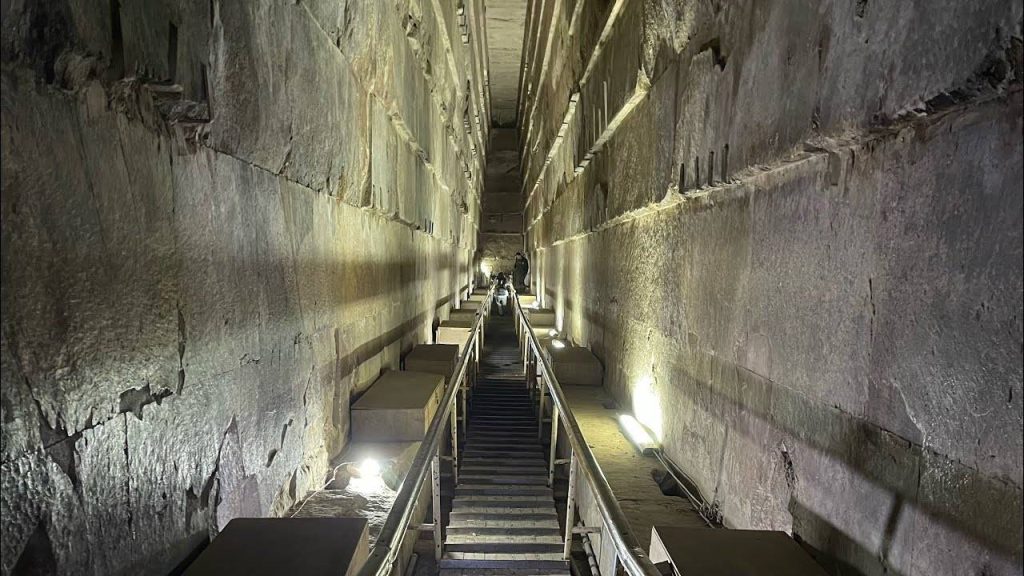
Inside the Great Pyramid
The interior is surprisingly simple. A descending passage leads to an unfinished chamber cut into the bedrock. An ascending passage leads to the so-called Queen’s Chamber (it never held a queen) and to the Grand Gallery, a corbelled hall about 47 m long and over 8 m high. At the top is the King’s Chamber with its lidless granite sarcophagus.
Research continues. In 2017 the ScanPyramids project used cosmic-ray muons to detect a large void above the Grand Gallery, and in 2023 a camera pushed through a gap confirmed an unfinished corridor behind the north face. Neither discovery changes the basic story; both remind us that the pyramid still has secrets.
Why the Great Pyramid still matters
For about 3,800 years the Great Pyramid was the tallest human-made structure on earth. Yet the real lesson of how the Great Pyramid was built is organisational: a state that could feed, house and coordinate thousands of workers, move millions of tonnes of stone and finish the job within a single reign. Standing at its base with a good guide, you can see the quarries, the causeway, the boat pits and the cemeteries of the officials who ran the project – the whole system laid out around you.
Frequently asked questions
Was the Great Pyramid built by slaves?
No. The archaeological evidence from the workers’ town and cemetery at Giza points to organised, fed and medically cared-for crews of skilled workers and rotating labourers, not slaves.
How long did it take to build the Great Pyramid?
Probably about 20 years. The work had to fit within Khufu’s reign, which lasted roughly two decades or slightly more.
How many blocks are in the Great Pyramid?
The usual estimate is about 2.3 million blocks, most of them local limestone, with Tura limestone for the casing and Aswan granite for the King’s Chamber.
Can you go inside the Great Pyramid?
Yes, with a separate ticket bought on site. The climb up the Grand Gallery is steep and narrow, so we do not recommend it for people with claustrophobia or limited mobility.
Sources & further reading
- AERA – The Lost City of the Pyramid Builders – excavations of the workers’ town at Giza
- Smithsonian Magazine – The World’s Oldest Papyrus and What It Can Tell Us About the Great Pyramids – on the Merer papyri from Wadi al-Jarf
- Digital Giza (Harvard University) – archive of excavation records from the Giza plateau
- UNESCO World Heritage – Memphis and its Necropolis
- The Metropolitan Museum of Art – Egyptian Art in the Age of the Pyramids (free to read online)
Written by the Deluxe Travel Egypt team and checked against the published sources above. Last updated October 2026.
Stand where the pyramid builders worked
Visit Giza privately with a licensed Egyptologist who will explain the evidence on site.
Send an enquiry WhatsApp +201000569259 WhatsApp +201221418581