
However, behind the pyramids lies another Cairo that many visitors miss: a dense medieval city of domes, minarets, carved gateways and lively lanes, listed by UNESCO as Historic Cairo. Usually called Islamic Cairo, it holds one of the richest concentrations of Islamic architecture anywhere in the world. This guide explains how the city grew, which monuments matter most and how to explore it.
At a glance
- Founded: al-Qahira was founded in 969 AD by the Fatimid dynasty
- UNESCO: “Historic Cairo”, World Heritage Site since 1979
- Must-sees: Ibn Tulun, al-Azhar, al-Muizz Street, Sultan Hassan, the Citadel
- Nickname: “the city of a thousand minarets”
- Time needed: one full day for the highlights; two to go deeper
- Dress code: shoulders and knees covered; women bring a scarf for mosques
How Islamic Cairo grew
In fact, Cairo grew as a series of capitals, each built next to the last. After the Arab conquest, Fustat was founded in 641–642 near the Roman fortress of Babylon. The Abbasids added al-Askar, and in the 870s the governor Ahmad ibn Tulun built his own capital, al-Qata’i, of which his great mosque survives. In 969 the Fatimids founded a walled palace city to the north and named it al-Qahira, “the Victorious” – the origin of the name Cairo.
Afterwards, later dynasties filled the city with monuments: the Ayyubids of Salah al-Din (Saladin) built the Citadel, the Mamluk sultans (1250–1517) covered it with domed mosques, madrasas and charitable foundations, and the Ottomans added houses, fountains and schools. What you see today is the layered result.
The Mosque of Ibn Tulun
Completed in 879 AD, the Mosque of Ibn Tulun is the oldest mosque in Cairo surviving in something close to its original form, and one of the largest. In addition, its vast courtyard, arcades of brick piers with carved stucco and its unusual minaret with an external spiral staircase make it one of the most peaceful places in the city. Also, next door, the Gayer-Anderson Museum occupies two restored Ottoman-era houses.
Al-Azhar and al-Muizz Street in Islamic Cairo
Founded by the Fatimids in 970–972, al-Azhar Mosque soon became a centre of learning and remains one of the most important institutions of Sunni Islam. Its courtyard, with minarets from several periods, is a good place to start a walk.
From here, al-Muizz li-Din Allah Street, the main street of the Fatimid city, runs north to the 11th-century gates of Bab al-Futuh and Bab al-Nasr. Along it stand some of the finest Mamluk buildings in Cairo, including the complex of Sultan Qalawun (1284–85) with its hospital, mausoleum and madrasa, and the madrasas of al-Nasir Muhammad and Barquq. Off the street, Bayt al-Suhaymi is a beautifully preserved Ottoman merchant’s house with courtyards and wooden mashrabiya screens.
Plan your visit
Explore medieval Cairo on foot with a licensed guide, including the Citadel and Khan el-Khalili.
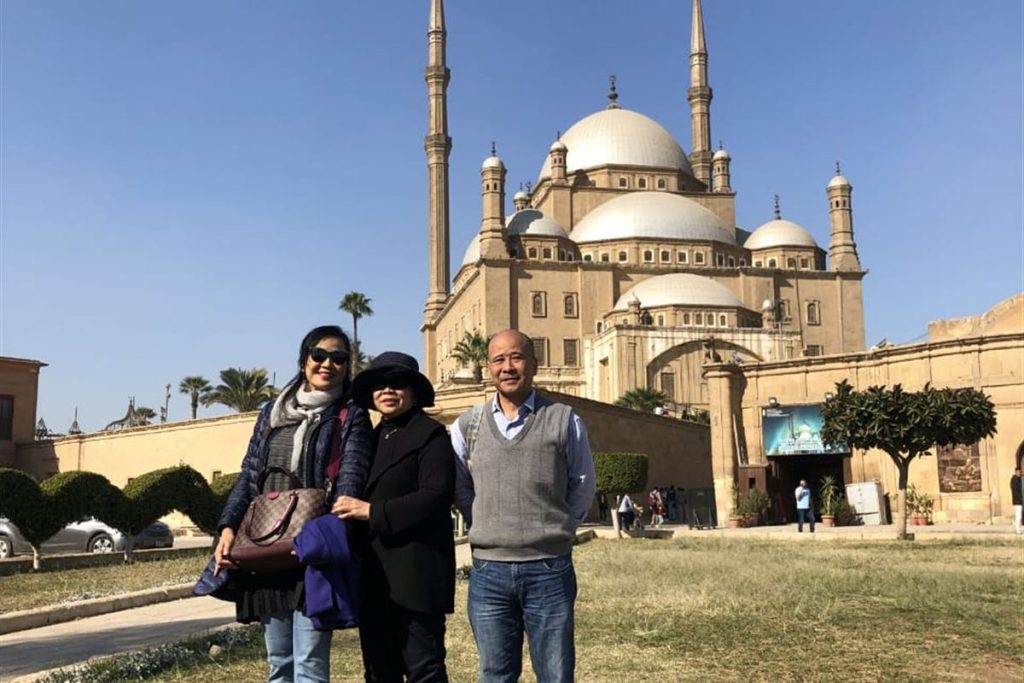
Sultan Hassan and the Citadel
Further south, below the Citadel, rises the colossal Mosque-Madrasa of Sultan Hassan, built in 1356–1363. Its four great vaulted halls (iwans) around a central courtyard housed teaching for the four schools of Sunni law. It is one of the masterpieces of medieval architecture. Opposite stands the al-Rifa’i Mosque, completed in 1912, which holds the tombs of members of Egypt’s former royal family.
Above them, meanwhile, the Citadel of Salah al-Din, begun in 1176, was the seat of government for nearly 700 years. Its skyline is dominated by the Ottoman-style Mosque of Muhammad Ali (1830–1848), sometimes called the Alabaster Mosque, with panoramic views over the city.
Darb al-Ahmar and Bab Zuweila
By contrast, south of al-Azhar, the Darb al-Ahmar district is quieter and more residential, with workshops and small mosques. Highlights include the southern gate of Bab Zuweila (1092), whose twin minarets you can climb for a view over the rooftops, and the Mosque of Aqsunqur, known as the Blue Mosque for its Ottoman tiles. Moreover, much of the area has been restored by the Aga Khan Trust for Culture alongside the creation of Al-Azhar Park on a former rubbish dump next to the medieval Ayyubid walls.
Tips for visiting Islamic Cairo
- Dress modestly. Cover shoulders and knees. Women should carry a scarf to cover their hair in mosques.
- Shoes off. You will remove your shoes in prayer halls; a small tip for the shoe keeper is customary.
- Avoid Friday noon. Mosques are busy with prayers around midday on Fridays; visits are better in the morning or later in the afternoon.
- Walk. Many lanes are pedestrian or too narrow for cars. Comfortable shoes are essential.
- Go with a guide. Inscriptions, styles and dynasties change from one building to the next; a guide makes sense of them.
Frequently asked questions
What is Islamic Cairo?
It is the historic medieval core of Cairo, founded by the Fatimids in 969 and filled with mosques, madrasas, gates and markets from many dynasties. UNESCO lists it as “Historic Cairo”.
Can non-Muslims visit mosques in Cairo?
Yes, most historic mosques welcome visitors outside prayer times. Dress modestly, remove your shoes and women should cover their hair.
What is the oldest mosque in Cairo?
The Mosque of Amr ibn al-As in Fustat was founded in 641–642 but has been rebuilt many times. The Mosque of Ibn Tulun (879) is the oldest preserved in close to its original form.
How long do I need for Islamic Cairo?
One full day covers the main highlights. Two days let you add Darb al-Ahmar, Ibn Tulun and the museums at a relaxed pace.
Sources & further reading
- UNESCO World Heritage – Historic Cairo
- Archnet – Masjid al-Sultan Hasan – architectural description and plans
- Aga Khan Development Network – The Azhar Park Project and the Revitalisation of Darb al-Ahmar
- Archnet – Cairo: Renewing the Historic City (free publication)
Written by the Deluxe Travel Egypt team and checked against the published sources above. Last updated October 2026.
Discover the city of a thousand minarets
Let a local guide lead you through a thousand years of Cairo’s history, at your pace.
Send an enquiry WhatsApp +201000569259 WhatsApp +201221418581